Your ski boots are the single most important piece of equipment in your setup. They’re your connection between your body and the snow, giving you the control and precision to carve, turn, and ski. A proper fit can make or break your time on the mountain, that’s why it’s worth taking the time to understand what makes a great fit. 

We’ll break down everything you need to know about how to choose a ski boot, from sizing and flex to volume, width, and different boot constructions. Whether you’re a beginner or an expert skier, the goal is to find a boot that offers the best balance of comfort and performance, allowing you to ski better and longer for many seasons to come. 

What We'll Cover:

Determining the Right Ski Boot Size

Let’s start with the basics: ski boot sizing.

Unlike normal shoe sizing, ski boot sizing is based on a measurement known as mondo or mondopoint, which is the length of your foot in centimeters. Mondopoint is a direct correlation of your centimeter measurement, so if your foot measures 26.5 cm, your mondo size is 26.5. You can measure this at home by standing on a piece of paper, marking the longest point of your foot, and measuring the distance. Measure each foot and use the longer measurement.

There’s also the option to use a chart to convert your shoe size to mondo point, but be cautious since this method tends to be less accurate. Ski boot conversion charts tend to size people in too large a boot. With ski boots, we’re looking for a close fit that holds your foot securely and prevents it from sliding around. Too much room is not only painful but also gives you less control while skiing.

A note about half sizes: Half sizes aren’t really a thing in ski boots. Ski boot shells come in full size increments, on the half, so you’ll find sizes 25.5, 26.5, 27.5, and so on. In other words, a 26.0 and 26.5 share the same shell. With a good boot fitter, the liners and boots can be adjusted and modified to fine-tune the fit.

How Does Ski Ability Affect Ski Boot Fit?

Along with your foot measurements, it’s also important to consider other factors like skiing ability that affect ski boot fit:

  • Beginner skiers tend to prioritize comfort and commonly choose a boot size close to or slightly longer than their mondopoint size. A common problem among beginner skiers is boot discomfort, often caused by ill-fitting boots. Many times, it's from being too big a boot that causes their feet to slide around and leads to pain spots. Opt for a snug fit, knowing the liner will break in.
  • Intermediate skiers should aim for a secure fit that is a size close to or slightly smaller than their indicated size. It’s important to also find a boot that matches the width of your foot shape for a close fit.
  • Advanced and expert skiers commonly choose boots based on their mondo size or a size smaller for a tighter, more responsive fit. Sizing down may call for additional work with a skilled bootfitter to make the boot comfortable, but the extra work is worth the superior performance you get from a close-fitting boot. In addition to a close fit, advanced and expert skiers often look for stiffer boots for better performance.


Ski Boot Width and Volume

Once you’ve nailed down your boot size, the next step is figuring out your ski boot width and volume.

Width—also referred to as the “last”— is the space at the widest part of your foot, measured in millimeters. Volume is the amount of internal space in the boot—around the forefoot, the ankle and heel, and in the upper cuff, calf area.

Ski boots typically fall under one of the three categories:

  • Low volume: Narrow boots, around a 98mm last
  • Mid Volume: Average width, around a 100mm last
  • High Volume: Wide width boots with a last of 102mm or above

    Keep in mind: These measurements are based on a size 26.5 boot. For every size up or down, the boot last changes by 2mm per size.

Back to Top

How to Know If the Volume Is Right

In a good-fitting ski boot, you should be able to wiggle your toes, but not have so much room that your foot can slide around when the boot is buckled. If a boot is too narrow, your foot will likely feel pressure points on the sides of your foot. An excessively wide boot will cause your foot to move from side to side, causing poor control while skiing.

Too tight a ski boot can also cause problems along your instep or top of your foot. Aim for light, even pressure across the top of your foot, especially if you have high arches. Too much pressure here can reduce circulation to your toes, leading to cold feet and numbness.

Also consider the heel pocket of the boot. Your heel should fit snug in the back of the boot, without pain or movement. This is where your control comes from. Any looseness here can cause your foot to shift or lift inside the boot, resulting in poor edge control and a sloppy skiing feel.

Today, almost all ski boots are heat-moldable, meaning they can be adjusted to better fit the contours of your foot. Bootfitters can stretch and make more room in specific areas without needing to size up, which helps maintain performance while improving comfort. Before jumping to the next size up, talk with an experienced boot fitter and consider whether making some adjustments will solve your problems.

And a reminder about fit: Like all things related to ski boots, use your measurements as a guide for where to start. Based on your personal preferences, you may find that a boot that matches your measurements might feel too big or too small. Some may tolerate a tighter fit than others. Those who want a super close fit may choose a lower volume and/or a smaller size and stretch the boot so it fits comfortably.

Understanding Ski Boot Flex

Flex refers to how stiff a ski boot is—essentially, how much force it takes to bend the boot forward. Adult ski boots are rated on a flex index that typically ranges from around 60 to 130 or higher. A higher flex index means a stiffer boot that requires more force to bend or flex the boot; a lower flex indicates a softer, more forgiving ski boot.


Stiffer ski boots offer more direct energy transfer, providing better control and precision, which is ideal for advanced skiers navigating challenging and technical terrain. Softer boots are easier to flex, making them more comfortable and forgiving—perfect for beginners or those who prioritize comfort over aggressive performance.

Here’s a general flex guide to get you started:

Keep in mind that flex ratings aren’t standardized across brands. So, a boot with a 100 flex in one brand may feel slightly softer or stiffer than another. Use flex ratings as a general guide, and try on boots when possible to get a true feel for their stiffness and fit.

Determining the Right Flex


When choosing the right boot flex for you, consider a combination of these factors:

  • Weight: Heavier skiers can flex a boot more easily, so a stiffer boot would be ideal and improve control. Lighter skiers may struggle to flex stiff boots and should consider softer options for easier handling.
  • Skill Level: Stronger and more experienced skiers generally prefer stiffer ski boots for quicker response and precision. A softer ski boot is ideal for beginners and more casual skiers, as it is easier to control, more forgiving of mistakes, and more comfortable.
  • Terrain: The type of terrain you ski most often plays a role. For example, racers who are mostly on steeper, hard-packed, groomed trails and ski fast and aggressively, ski stiffer boots for max precision and control.
  • Personal Preferences: Ski boot flex also comes down to personal preferences. Skiers with limited ankle mobility may need a softer boot to flex it properly. Some skiers simply prefer the feel of a stiffer or softer boot, and some may prefer the comfort of a softer boot over a stiffer boot.

Ultimately, it’s important to choose a boot that you’re able to flex properly without overflexing and crushing the boot. A boot that’s too soft will feel sloppy and require more effort to control your skis. One that’s too stiff a boot can force you into too upright a position, making it difficult and more tiring to ski.


Back to Top

What Does a Good Ski Boot Fit Feel Like?

Ski boots should have a snug fit that doesn't cut off circulation or cause painful pressure points. With the boot properly buckled…

  • The boot should wrap around your calf and lower leg without any gaps or pinching.
  • When standing tall with your boots properly buckled, your toes should be flat and not curled, and be able to feel the front of the boot.
  • Flex the boots a few times by bending your knees and putting pressure on the tongue of the boot. This puts you in the proper skiing position. You should feel your heel in the back of the heel pocket, and your toes should pull away from the front of your boot, giving you room to wiggle your toes.
  • The ankle and heel should feel secure without any heel lift when flexing forward.
  • The lower portion of the boot over the instep shouldn’t be too tight, just enough for even, light pressure throughout.

It should feel snug, like a firm handshake. If you find that even after spending some time standing and flexing in your boots, you still experience discomfort or pressure points, consider taking your boots to a bootfitter who can assess and make adjustments to dial in your fit.

Back to Top

Types of Ski Boot Constructions

There are a few different ski boot constructions, each aiming to address different problems a skier might face when it comes to finding the right ski boot. Here’s a breakdown of the different types of ski boots:
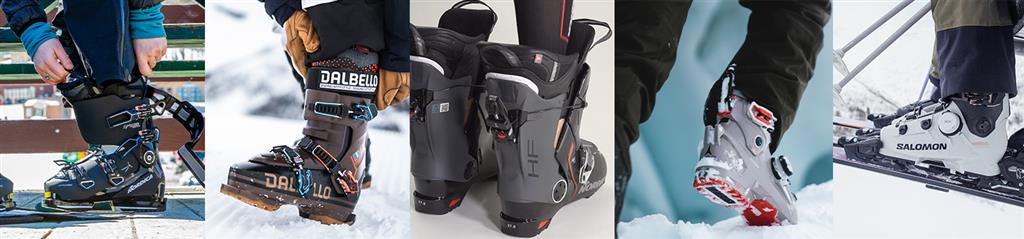
Traditional Overlap Ski Boots

The most common type, and probably what comes to mind when you think of ski boots, are the traditional overlap ski boots. They consist of a two-part shell: the upper cuff and lower foot. They overlap and connect above the ankle and are usually secured with four buckles. Traditional overlap boots are available at every level, from entry-level kids' boots to World Cup racers. They offer excellent power transfer and control.

A criticism of overlap boots is the struggle to get them on and off. The boots are snug, and the bend around the ankle can be a problem for some. However, boot manufacturers are continually making improvements to the overlap design to create a more comfortable fit without compromising performance.

Cabrio, 3-Piece Boots

The cabrio boot emerged in the 80s and rose to fame soon after due to its unique three-piece shell design. A cabrio shell features a lower portion around the foot, an upper cuff, and a separate tongue. The tongue is on a hinge at the top of your toes that allows it to open completely, for easy entry and exit, and a more progressive flex. Cabrio boots also have different buckles and buckle placement along the ankle joint, adding additional ankle support and reducing heel lift. Though not as popular or as many options as traditional four-buckle boots, cabrio boots have become popular among freestyle skiers and those looking to address specific fit problems.

Rear Entry Ski Boots

Rear-entry boots gained popularity in the 90s for their ease and comfort. Unlike traditional, overlapping boots, which can be difficult to get into, rear-entry ski boots allow the back of the boot to move, creating a wider opening for seamless entry. Although they do not offer as close a fit, which leads to less precision and control than four-buckle boots, rear-entry ski boots bring comfort and ease to those who may not be able to ski in four-buckle boots.

Alpine/AT Hybrid Boots

AT ski boots are designed for both uphill travel and downhill skiing, enabling skiers to explore more of the mountain. AT boots feature a hike mode, tech pin inserts, a rubber sole, and tend to be lighter than traditional ski boots, making them a great hybrid option for experienced skiers to skin up the mountain and explore beyond the resort. AT boots are available in traditional overlap and cabrio designs.

Boa Boots

New to the ski boot world, Boa ski boots use Boa technology instead of traditional buckles on an overlap boot. Introduced during the 2023 season, Boa ski boots were first seen when they replaced the lower two buckles of the boot. To address the common problem of too much pressure on the instep, the lower Boa provides superior wrap around the foot and more even pressure distribution rather than clamping down on top of the foot.

As of the 25/26 season, you can find boots that feature dual Boa or upper Boa dials, which offer a more effective wrap around the leg without creating pressure points. The configuration of the upper Boa allows for increased power transfer to the skis, resulting in a more seamless feel.

Back to Top

What’s the Difference Between Men’s and Women’s Ski Boots?

Women’s ski boots are designed to accommodate the anatomical differences between men and women, addressing common problems women face with ski boot fit. Here are a few differences:

Women’s ski boots offer smaller sizes, usually ranging from 22.5 to 27.5, while men’s boots usually start around 24.5 or 25.5 and go up to 32.5.

Women’s boots also come in softer flexes, starting around 65 for lighter, more casual skiers and going up to 115 and beyond for more experienced and aggressive skiers. Men’s boots tend to start around 80 and go up to 130 and beyond.

To address the anatomical differences between men and women, women’s boots tend to have a narrower heel pocket, a greater forward lean to compensate for women’s lower center of gravity, and lower cuff height for a better fit around the calf and better leverage. Women’s boots also tend to have warmer liners, since women often tend to run cold.

Just because there are women’s specific boots, doesn’t mean women have to get women’s boots or vice versa. For example, women who are taller, have a large mondo size, and ski more aggressively may benefit from a men’s or unisex ski boot. A shorter man with a mondo size of 24.5 or smaller would benefit from the correct size and lower cuff height for better leverage that women’s ski boots offer. When selecting your ski boots, it’s essential to evaluate and choose a boot that meets your individual needs.

Back to Top

Final Thoughts: Find the Best Ski Boots for You

Selecting the right ski boots is a crucial step in optimizing both your performance and comfort on the mountain. As the primary connection between your body and your skis, ski boots directly influence how effectively you can transfer energy, maintain control, and respond to varying terrain.

A proper fit is not just about comfort—it plays a significant role in your overall skiing experience. Boots that are too loose can reduce precision and increase fatigue, while overly tight boots can lead to circulation issues and discomfort. By carefully considering factors such as size, width, flex, and construction, you can ensure that your boots are tailored to your foot shape, skill level, and skiing goals.

Keep in mind that finding the best ski boots often requires more than just matching measurements. A professional boot fitting can help address specific fit challenges and fine-tune the boot to your unique anatomy, resulting in improved performance and a more enjoyable day on the slopes.

Ultimately, investing the time to find the right ski boots pays off in both short-term comfort and long-term skiing success. With a dialed-in fit, you'll ski more efficiently, feel more in control, and make the most of every run.